
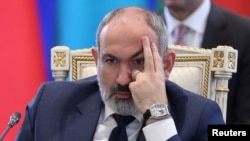
Prime Minister Nikol Pashinian announced in early 2024 the suspension of Armenia’s membership in the CSTO, accusing Russia and other member states of failing to honor security commitments to his country. The move added to his government’s mounting tensions with Moscow.
Pashinian indicated earlier this year that Yerevan will leave the alliance altogether in the near future. But he did not specify possible dates for the exit.
“No such task has been set for us yet,” Deputy Foreign Minister Mnatsakan Safarian told reporters. “If there are such developments, you will naturally know about it.”
Neither Safarian nor parliament speaker Alen Simonian would say why Armenia is still not formally withdrawing from the CSTO. Simonian, who is a top political ally of Pashinian, said only that the South Caucasus country has effectively stopped being part of the bloc.
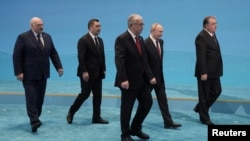
Pashinian has boycotted CSTO summits held over the past two years. A senior aide to Russian President Vladimir Putin, Yury Ushakov, said late last week that the Armenian premier will also not attend the next summit that will take place in Kyrgyzstan on Thursday. According to Ushakov, Yerevan will at the same time not veto documents that are due to be adopted there.
“We do not participate [in CSTO summits,] but we do not hinder the adoption of decisions or documents either,” confirmed Safarian.
Nor has Pashinian demanded so far that Russia close its military base in Armenia or withdraw its border guards from the country’s borders with Turkey and Iran. Still, he pledged in September to step up “efforts aimed at Armenia's accession to the European Union.”
Russian officials have repeatedly warned of severe economic consequences of the Armenian leadership’s desire to eventually join the EU. They have said, in particular, that Armenian exporters would lose their tariff-free access to the Russian market guaranteed by Armenia’s membership in the Eurasian Economic Union (EEU).
Pashinian declared in August that Yerevan will eventually have to choose between the EU and the Russian-led trade bloc. According to official statistics, Russia accounted for over 35 percent of Armenia’s foreign trade in the first half of this year, compared with the EU’s 12 percent share.