

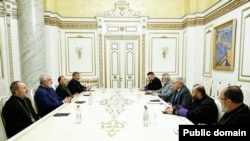
Eight of them met with Pashinian on Thursday evening after issuing a joint statement that accused Garegin of covering up a sex scandal involving another archbishop, who is loyal to him and highly critical of Pashinian.
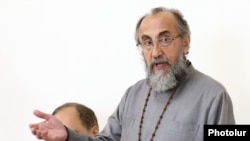
Early this month, a presumably government-linked account on the Telegram social media platform circulated a sexually explicit video purportedly featuring Archbishop Arshak Khachatrian, the outspoken head of the church’s Mother See Chancellery in Echmiadzin. Khachatrian dismissed the video as fake, saying that it was generated by artificial intelligence.
Garegin set up a commission of senior clerics tasked with looking into its authenticity and recommending, if necessary, punishment for Khachatrian. The statement released by the rebellious bishops charged that the Catholicos is “trying at all costs to cover up Arshak's sacrilegious act” by torpedoing that internal inquiry. They also urged other bishops as well as laymen to join them in “cleansing the Mother See of Holy Etchmiadzin from the sacrilegious clergyman and those who share his sin.”
The appeal was widely construed as an indirect endorsement of Pashinian’s controversial campaign against Garegin. Not surprisingly, the premier swiftly welcomed it before receiving the eight bishops, some of whom head church dioceses in Armenia. By contrast, opposition leaders and other critics of Pashinian accused them of betrayal and involvement in what they see as an anti-church conspiracy.
Garegin’s office likewise condemned them and rejected their accusations in a statement issued on Friday. It said, in particular, that the commission investigating Khachatrian never held any meetings or heard his arguments otherwise. It said that as recently as on Tuesday the commission members, among them rebellious bishops, unanimously agreed to the formation of a smaller body empowered to suspend Khachatrian pending the outcome of the inquiry.
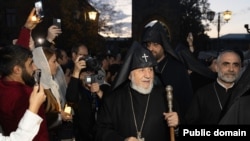
The Mother See also disputed their claim that Armenia’s Investigative Committee has formally examined and confirmed the authenticity of the scandalous video. The law-enforcement agency has so far declined to comment on that.
“Thus, it is evident that the accusations made in the statement against the Catholicos of All Armenians are entirely unfounded and fabricated and that the targeted harassment and formation of prejudiced opinions against His Eminence, the archbishop, are wholly unacceptable,” read the statement
The Mother See stopped short of defrocking or taking other action against the accusers. It urged them instead to “return to the canonical framework and express their concerns solely within the Church’s highest governing bodies.”
Its statement was released after an aborted meeting of the church’s Supreme Spiritual Council. Among its members are five of the bishops challenging Garegin. Their absence prevented the council from making a quorum.
Pashinian began pressuring the top clergy and Garegin in particular to resign in late May, saying that they have had secret sex affairs in breach of their vows of celibacy. His detractors say that he is simply trying to please Azerbaijan and/or neutralize a key source of opposition to his unilateral concessions to Armenia’s arch-foe. They have denounced Pashinian’s campaign as illegal, arguing that the church’s separation from the state is guaranteed by the Armenian constitution.
Pashinian threatened on June 26 to forcibly remove Garegin from the church’s Echmiadzin headquarters the day after law-enforcement authorities arrested Archbishop Bagrat Galstanian, who led massive anti-government protests in Yerevan last year. Galstanian and 17 of his supporters went on trial on coup charges denied by them.
Another vocal critic of Pashinian, Archbishop Mikael Ajapahian, was arrested and charged on June 27 with calling for violent charge. Ajapahian, who heads the church diocese in the northwestern Shirak province, was sentenced to two years in prison on October 3 at the end of an unusually speedy trial.
The crackdown continued with the arrest later in October of Bishop Mkrtich Proshian, Garegin’s nephew heading another diocese. Another nephew of the Catholicos as well as his brother, layman Gevorg Nersisian, were arrested in early November for allegedly obstructing a pro-government party’s local election campaign in their village. They too reject the accusations as politically motivated.
Pashinian’s political allies expressed confidence on Friday that Garegin’s resignation is a forgone conclusion. Priests loyal to the Catholicos dismissed such claims, saying that the unprecedented revolt will not force him to quit.
“A Catholicos could resign only if there is a theological deviation from our faith,” one of them, Father Vrtanes Baghalian, told reporters in Echmiadzin.
Baghalian claimed that the authorities may have blackmailed the clerics involved in the revolt with discrediting material.
One of them, Archbishop Navasard Kchoyan, is the head of the church’s largest Ararat Diocese encompassing Yerevan. Kchoyan had long caused controversy with his extravagant lifestyle and reportedly close ties with Armenia’s former government. He was charged with fraud and money laundering but not arrested in August 2023.
Another rebel, Bishop Arakel Karamian, is believed to be the biological father of Argishti Kyaramian, a Pashinian ally who headed the Investigative Committee until last December.