

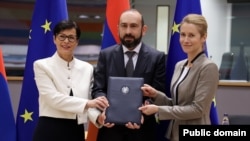
The EU’s foreign policy chief, Kaja Kallas, and Armenian Foreign Minister Ararat Mirzoyan signed the document after talks in Brussels. Kallas also announced 15 million euros ($17.4 million) in additional EU aid designed to make the South Caucasus nation “more resilient.” She said part of it will be used for countering the alleged Russian interference.
“Russia and its proxies are already ramping up disinformation campaigns in Armenia ahead of the next year's parliamentary election,” Kallas told a joint news conference. “We see the same networks that we saw deployed in Moldova that were active, so the playbook is identical. Our EU funding will also cover detection, analysis and response to foreign interference.”
Mirzoyan did not explicitly echo her accusations. He only spoke of “new engagements to counter hybrid threats” facing his country.
“The message of today’s meeting is clear: the Armenia-EU partnership is entering a new and more ambitious phase with a shared vision and responsibility to further deliver meaningful results for our citizens,” added Mirzoyan.
In his words, the document signed by him and Kallas will “complement” and go “far beyond” the Enhanced Partnership Agreement (CEPA) signed by Brussels and Yerevan in 2017. It was not immediately clear whether it says anything about the possibility of Armenia’s future membership in the EU.
Amid heightened tensions with Russia, the Armenian government pushed through the parliament this spring a law declaring the “start of a process of Armenia's accession to the European Union.” But it has yet to submit a formal membership bid. Nor has any EU member states officially welcomed such a prospect.
Russian officials have repeatedly warned Yerevan of severe economic consequences of its desire to eventually join the 27-nation bloc. Prime Minister Nikol Pashinian appeared to defy those warnings in September, saying that his administration will step up “efforts aimed at Armenia's accession to the European Union.”
According to official statistics, Russia accounted for over 35 percent of Armenia’s foreign trade in the first half of this year, compared with the EU’s 12 percent share. Armenia also buys the bulk of its natural gas from Russia at a price that is set well below international market-based levels.
Kallas declined to say how the EU would help Armenia in case of Russian retaliatory measures that could prove devastating for the Armenian economy.
“We had extensive discussions about these issues today,” she said. “The world order is clearly changing, and that’s why the strategic alignment of the common foreign and security policy for our partners is extremely important: with whom you really are.”
Moscow has sought to downplay the tensions with Yerevan in recent months. Russian President Vladimir Putin said in September that Russian-Armenian relations are growing “in all areas.” He pointed to increased trade between the two countries which reached, according to Russian government data, a new record high of $11.7 billion last year.