


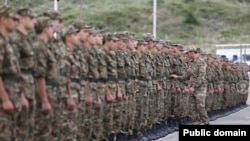
The government first announced those plans in early September with a bill drafted by the Armenian Defense Ministry. It would reduce the length of the military duty for male citizens from 24 to 18 months.
The measure was initially due to take effect next summer. However, Prime Minister Nikol Pashinian announced afterwards that it will apply to conscripts to be drafted from January 1 onwards. His critics described this as further proof that it is designed to earn the ruling Civil Contract party more votes in the general elections expected in June 2026.
Defense Minister Suren Papikian and parliament deputies from Civil Contract again denied that during a debate that preceded the bill’s passage by the National Assembly. Papikian continued to insist that the shorter service will not downsize Armenia’s armed forces already grappling with staffing problems. The resulting drop in the number of conscripts will be offset by more contract soldiers recruited in recent years, he said.
Opposition lawmakers, notably former Defense Minister Seyran Ohanian, remained unconvinced by those assurances. Voluntary military service in Armenia is still not attractive enough, they said, calling for major pay rises for contract soldiers.
The opposition has also argued that the Armenian military continues to regularly draft thousands of reservists for month-long combat duty on the Armenian-Azerbaijani border. One of Papikian’s deputies, Arman Sargsian, acknowledged in late September a shortage of military personnel. He urged the parliament to also adopt another Defense Ministry bill that calls for stricter punishment for reservists evading call-ups.
Critics have also accused Pashinian of bowing to Azerbaijan’s demands to downsize the Armenian army. The premier’s political allies have denied that. Still, two pro-government lawmakers said during Thursday’s debate that the shortening of the military service has also been made possible by “peace” established between Armenia and Azerbaijan.
Pashinian’s government plans to cut Armenia’s defense expenditures by over 15 percent, to 563 billion drams ($1.47 billion), next year.